Showing posts with label St Peter's church. Show all posts

Thursday, 9 October 2014

The Night Stair


Original photo from 1990 dig showing spiral stair
© Albion Archaeology, reproduced with permission
In 1990, workmen digging new drains on the south side of St Peter's church in Harrold uncovered the remains of a medieval spiral staircase.  There are no obvious clues as to what these stairs were for, but the assumption was made that they were something to do with the former Harrold Priory, which was known to be sited to the south of the church.


The remains form part of the foundations of the south east corner of the south aisle.  This aisle, it is clear from the records, archaeology and walls, was shortened at some stage in the late middle ages or early Tudor period.  Even before this shortening, a large doorway had been cut into this wall immediately above the remains of the staircase: this doorway was later blocked again on the outside, but is still clearly visible from within the church, where it can be seen behind the organ.

The 1990 work was overseen by Albion Archaeology from Bedford, and no further traces of Harrold Priory were found.  However, based on existing remains and archaeological work on other nunneries in England it is possible to speculate that the steps found at Harrold were the remains of the nuns' 'night stair'.   An example of one of these is described by Roberta Gilchrist and Marilyn Oliva at Carrow Priory in Norfolk.  This had a layout typical of medieval nunneries, with a row of monastic buildings joining the church at the south aisle - at the same point that the Harrold stair was discovered.  Carrow's stairs were in a 'slype' at the south transept, and led down from the nuns' dormitory.  They were used to allow the nuns access to their chapel for the night services (matins at 2 am daily).

Carrow's layout, with night and day rooms plus chapter house to the south of the church, and with cloisters attached to the west of these, was common enough both in women's houses and in men's.  Carrow had many similarities to Harrold Priory, having been founded in the same period, having been on the edge of a village, and having accommodated a maximum of a dozen nuns.  Carrow, like Harrold, was never well endowed and struggled on small benefactions and rents from landholdings.
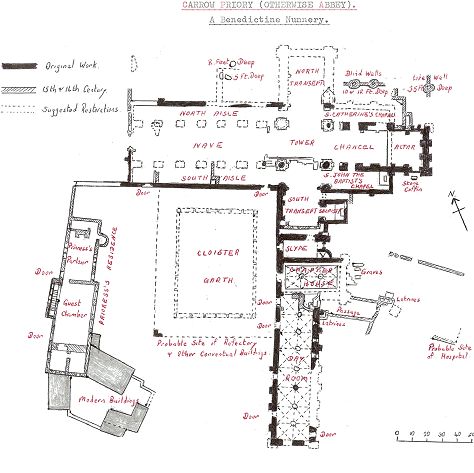

Plan of Carrow Priory in Norfolk (source: georgeplunkett.co.uk)
The night stair idea at Harrold does not fit the evidence readily, though.  Why was it removed and built over?  When the door was cut into the south aisle, how did the nuns gain access from the dortor at night?   One possible explanation is that the remains discovered in 1990 were from very early in the Priory's life, and were in something like Carrow's slype, attached to the main aisle or nave of St Peter's.  When, in the 14th century, a new south aisle was constructed, the nun's access to the church was rebuilt further south.  In this scenario the new night stairs would be in a lobby or slype, which would then give access to the south aisle via a new doorway.

It is also possible that there was more than one chapel to the south, as can be seen at Carrow.  Perhaps the nuns had a private chapel to the south of the chancel (where there are no windows), while there was a new general 'public' aisle to the south of the nave.  This again was a common medieval arrangement where the nuns shared their space of worship with the townsfolk. We do know from the Harrold Cartulary (a collection of legal documents, now in the British Museum), that the nuns' chapel was distinct from the main church, as the bishop of Lincoln had to remind the Prioress of her duty to supply bread and wine for both the main church and the nuns' private chapel (Document 207 cited in Fowler 1935).

A conjectural plan of Harrold Priory, taking the Carrow model, would have accommodation extending south from the main church, and forming the east side of the cloister.  The west side would be service accommodation - kitchens (possibly with running water in an artificial stream beneath), brewery, dairy, stores, etc.  The north side of the cloister would adjoin the church's south aisle while the south side of the cloister would be enclosed.  But whereas the nuns of Carrow built a new guest wing and infirmary to the west of the cloister in the late middle ages, at Harrold - we can speculate - a new 'modern' building of this kind went up to the east of the cloister.  This was a more serviceable and comfortable building, with the Prioress's private lodgings as well as rooms with fireplaces for corrodians (people who had paid to be cared for in their old age).  If the Norfolk pattern from Carrow was repeated in Bedfordshire, at the time of the dissolution this new wing was then remodeled into what then became known as Harrold Hall.


References

For more photographs of the Nuns' Stream and other remains, please visit my Harrold Priory collection on Flickr.


Wednesday, 8 October 2014

The Nuns' Stream


Remains of what may have been the walls of the Priory grounds
In 1268 Prioress Amice obtained the permission of Ralf Morin IV (Lord of the Manor of Harrold) to divert a brook.   As part of this agreement the Prioress undertook not to use the brook to drive a mill. The records do not specify where the stream was, but there is only one brook anywhere near to the site, the one running down what is now called Church Walk and then into the Great Ouse river.  This stream seems to have formed the western boundary of the Priory, and there are what appear to be the remains of substantial stone walls still standing here at what was probably the north west corner of the Priory precincts.

In their authoritative study of nunneries in East Anglia, Roberta Gilchrist and Marilyn Oliva found no evidence of diverted streams: indeed they point out that while the practice was common in men-only monasteries, "female houses seldom possessed such elaborate facilities".  Water was diverted to provide fresh water for the kitchens and channels to flush the monastic latrines. Eileen Power described how Abbess Euphemia had ordered a stream to be diverted for this purpose at Wherwell Abbey in the 13th century.  The agreement between Prioress Amice and Ralph Morin tells us that the new water course was not used for milling, but has no further details as to its purpose.

In September 2014 some local residents and I made a close inspection of the stream.  We had previously found a reference on the 1902 Ordnance Survey map to "sluices" part the way down the stream, as well as two footbridges.  We found no clear evidence of either, although there were some remains of a concrete structure on the bed of what we were now calling the Nuns' Stream.  However, we did find that downstream from the Wellocks bridge by Church Walk for about 100 metres, the stream had been carefully and substantially culverted between stone walls.  These were about 2 metres in height and extended the length of the stream to about 30 metres beyond the point where we suppose the sluices were installed (the stream takes a sharp right hand turn at this point).

What appears to be an arched entrance to a new underground
stream feeding the Priory with fresh water
The walls to the culvert are heavily overgrown now, and in places have been undermined by
flooding, but are still clearly visible.  As they follow the stream down from Wellocks, the space widens from about two metres to around five at its widest point.  This, with the stream being dammed by sluices lower down, would have created a very substantial artificial pond with a large head of water.  About a metre down from the top of the culverting, immediately before where we imagine the sluices were, there appear to be the remains of an arched opening to an underground channel to take water to the Priory.

This evidence, though, is inconclusive as the stream is heavily silted up at this point.  There is no evidence of the Priory stream today and it is likely to have been built over by later development in the 19th and 20th century.  However, on the opposite side of the former Priory site, along the banks of the Great Ouse, there are the remains of what appears to be a substantial stream or drain originating in the the remains of the Priory or Hall.  The outflow here is said to be arched and built of stone, similar to what we observed at the Nuns' Stream side of the site.  The remains are close to a Victorian boathouse, but have been buried in recent landscaping work by one of the local residents. This outflow is also visible on 19th century ordnance survey maps.

The new pond: stone lined, two metres deep and 5 metres wide
at this point.  A substantial body of water to feed the Priory.
It is possible that these works were done by one or other of the tenants at Harrold Hall, rather than the nuns at the Priory.  However, the stonework appears to be well weathered and consistent with other late medieval stonework nearby, such as the walls of St Peter's church.  My guess is that the nuns had the stream culverted in the 13th century, with an underground stream running to the western side of their cloister where perhaps there were kitchens or latrines.  The stream then carried on out and discharged into the Great Ouse. The flow of water into this culvert was controlled by means of sluices which kept a large head of water in the artificial pond on the edge of the site, and backing up Church Walk towards the High Street.


References
For more photographs of the Nuns' Stream and other remains, please visit my Harrold Priory collection on Flickr.


Wednesday, 3 September 2014

Financial mismanagement and fraud


As holders of the 'livings' of the parishes of Harrold, Stevington and Brayfield, as well as other properties further afield, Harrold should have been well provided for materially. But as we have noted in an earlier blog, by the 15th century at least, poverty was a fact at the Priory.  In about 1402 they made their case for additional funds: not only was the cost of providing hospitality prohibitive, but "on account of the flooding of a certain great river called the Owse they very often suffered great losses; that its houses, buildings and inclosures were in a ruinous state, and that its fruits, &c were insufficient for such hospitality, for rebuilding and for other burdens..." (cited in the Victoria County History 1912).

How can this have happened?  Where did the money go?  There are three possible explanations: firstly the costs associated with these estates, particularly the churches; secondly financial mismanagement by successive Prioresses; and thirdly fraudulent or deceptive transactions carried out by the Priory's lay patrons.  At times the problems could have been a combination of all three.

St Mary's, Stevington. The various additions of the middle
ages are clearly seen, including chapels which were later
abandoned.  Harrold Priory would have paid for these changes
The 'livings' of the parishes listed above brought income, certainly, but they also brought costs.  The Priory would be responsible for the stipends (salaries) of the cannons (priests) at Harrold, Stevington and Brayfield, and they would also have had to pay for building and maintenance.  The 12th,13th and early 14th centuries saw a more than doubling of the population in Bedfordshire, particularly in rural areas.  The churches were forced to adapt their buildings, and Harrold and Stevington in particular added new aisles, chapels and windows to accommodate the increased numbers of worshipers.  Each of the churches added or enlarged towers during this period, with St Peter's at Harrold building the elegant spire we still see today.

There were other costs associated with the Priory's role: for example the bridge and causeway across the Great Ouse at Harrold was built and maintained jointly by the manors of  Odell, Carlton and Chellington and Harrold Priory.   It may be that in more experienced hands these costs and transactions would have been managed well, but Harrold Priory, it seems, did not always have capable leaders.  Things would certainly have been much more difficult after the arrival of the Black Death in 1348: the revenues of all landowners including the communities at Harrold and Lavendon, were squeezed as labourers died and the survivors demanded better pay for their services.  Many tenant farms lay uncultivated for generations: rentals dropped or dried up altogether and it was another 400 years before the population levels had recovered.

In 1442-1443 Bishop Alnwick of Lincoln complained that the Prioress of Harrold non reddidit compotum, meaning that she had not submitted annual accounts.  Indeed it seemed that she kept no records at all of transactions and had therefore been compromised when tradespeople demanded double the payment for goods or services than had been agreed.  As well as other shortcomings, the Bishop noted that the Prioress had sold a corrody (a lifetime's allowance of shelter, food and drink) for 20 marks, presumably far less than it cost to provide.  She was also rebuked for allowing woodland belonging to the Priory to be cut down, timber being a highly valued resource for building and for firewood.

At the time of the Bishop's visit, Harrold was in debt to the tune of 20 marks (13 pounds 12 shillings and 8 pence), a substantial amount equivalent to several months of rental income, but by no means the highest level of debt in the diocese.  But the Bishop singled out Harrold and stipulated in detail the type of agreements for which the Prioress was required to gain prior approval from Lincoln - contracts, grants of land, pensions, annuities, etc.  To make it clear, he told her that she and her successors must agree to this arrangement "vnder the payne of priouacyone" (Power, 2010, p.226).  All of this suggests that there was little attention being paid to these things and that the Priory's estates were being whittled away.

There was also the suggestion that some of the Priory's patrons were advising the nuns, not in the interests of the community but to the patrons' benefit.  This included the Priory selling or making grants of land or other property to local landowners at below market rates.  The Bishop's representatives also believed that the nuns had been fraudulently deceived in some cases and had signed documents written in latin without having any idea what they were giving assent to.

Interestingly, the same accusations were made in 1536 by the King's commissioner Dr Layton when he reported to Thomas Cromwell prior to the closure of Harrold Priory. Layton describes how "Lord Mordaunt had induced the prioress and her 'foolish young flock' to break open the coffer containing the charters of the priory, and to seal a writing in Latin of which they did not understand a word, but were told it was merely the lease of an impropriate benefice. 'All say they durst not say him nay,' he adds; 'and the prioress saith plainly that she would never consent thereto.'" (taken from A History of the County of Bedford, Volume 1).   Lord Mordaunt's ancestral seat was in nearby Turvey.  As the History's author notes, there is no actual evidence against the patron, "But unhappily there is nothing at all improbable in the story of Lord Mordaunt and the charters. The patron of a house so small and so poor would be in a position to take a very high hand with the little convent, especially as one or two of the nuns would very likely be members of his own family."

It is sad to reflect that Harrold Priory, for all its lands and buildings, should have been reduced to a state of poverty by a combination of misfortunes and mismanagement. Proper care and attention would have allowed it to continue its work in the Harrold community, providing for travelers, feeding the poor and caring for the sick.  At least there is a legacy in the fine church buildings at Stevington, Cold Brayfield and Harrold.


Sources
  • Power, Eileen (2010), Medieval English Nunneries: C1275 to 1535, Cambridge University Press
  • Spear, Valerie (2005), Leadership in Medieval English Nunneries, Boydell Press.
  • 'House of Austin nuns: The priory of Harrold', A History of the County of Bedford: Volume 1 (1904), pp. 387-390.  http://www.british-history.ac.uk/report.aspx?compid=40042
  • 'Parishes: Harrold', A History of the County of Bedford: Volume 3 (1912), pp. 63-68. URL: http://www.british-history.ac.uk/report.aspx?compid=42384 
  • 'House of Premonstratensian canons: The abbey of Lavendon', A History of the County of Buckingham: Volume 1 (1905), pp. 384-386. URL: http://www.british-history.ac.uk/report.aspx?compid=40317


Saturday, 23 August 2014

Daily life for the nuns of Harrold


Harrold Priory was a small community of nuns, probably never numbering more than 12 plus the prioress.  We know very little about them, as the few surviving records tend to be legal documents and rarely concern themselves with individuals and the everyday work of the Priory.  However, most orders of nuns, whether following the Rules of Benedict (as nearby Elstow did) or Augustine (as Harrold did), followed a similar routine.  Richard Chipchase has written the following general description of daily life, which would probably have applied to Harrold Priory in most respects:

"[The nuns] would rise at 2am for Matins Laud, the first service of the day. After this they would return to bed and rise again with the sun. At this point [they] would wash and have breakfast. Nuns usually drank beer with their meals due to it being cleaner than the water. At 7am they would go to Prime, the second service of the day. After this the nuns would meet in the chapter house where readings from the Bible would be heard [and the business of the day discussed]. The third service was Tierce at 9am and following this the nuns would occupy themselves with work in the convent until midday and the fourth service, Sext None. After this, they would eat before returning to their work until Vespers, the fifth service of the day which started at 5pm. This would be followed by a light supper and later the final service of the day, Compline, which took place at 7pm. The nuns went to bed after this, ready for the process to start again at two the next morning. This format varied through the different orders with some splitting Matins and Lauds, having an extra service at 5am. Others would split Sext None with a service at noon and another at 3pm."

Modern-day nuns at prayer: source Augustiniannuns.org
All of these services would be marked with the ringing of bells, and Harrold folk would in turn be measuring the day by reference to these.  The reports of local courts contain references to the time of day related to the hours of the office.  In a flat landscape like north Bedfordshire the sounds of the bells would carry great distances.  Today in Harrold the bells of St Peter's church still ring the hours and the quarter hours - but not the offices of the day.

Chipchase goes on:

"The nuns did various types of work while in the convent, they also received an education with many learning to read and write. Often, the convent was the only source of education for women during the middle ages. The nuns had also various tasks to do including washing and cooking, farming, brewing, bee-keeping, medical care, teaching, spinning, weaving and embroidery and illuminating manuscripts. It was usual for nuns from wealthy families to be given the lighter tasks and very often the convent had its own lay sisters who carried out a lot of the manual work. These were members of the convent who were not bound to the various services of the day. The nuns themselves had various roles within the convent, the head of which was the Abbess, a position which was for life. Other titles were the Almoner, any nun who dispensed alms to the sick and needy. Other roles were the Cellarer, who was basically the convent housekeeper and the Infirmarian who looked after the infirmary."

This latter point is important in Harrold, as the nuns cited the needs of the poor and travelers in appeals for charity right up to the late middle ages, stating that providing these was stretching the community's resources. But as Chipchase notes, the life of the nuns centred on the spiritual.  At Harrold the nuns would take part in the main sacraments (for example holy mass) through St Peter's church where they may have had an adjoining chapel, separated from the main congregation.  They also had their own chaplain who may have provided other sacraments (for example confession) in the Priory itself.  The daily services would probably have been held in the Priory, and nuns were put in charge of this, as Chipchase goes on to say:

The Sacrist was an educated nun who would be in charge of all books, vestments and vessels and was also a medieval property manager being responsible for maintenance. Finally, there was the Prioress. This role was taken by a senior nun and in an Abbey she was the Abbess’ deputy and in a convent without the status of an abbey, she would be in charge... "The most important part of the nun’s day were the services, the day was entirely structured around these and any work ceased immediately at times of prayer."


Sources

  • Richard Chipchase, The Daily Life of a Nun in Medieval England, published: June 14, 2011 on Humanities360.com
  • Hull, Robert – Nun (Medieval Lives) – Franklin Watts (2008)
  • Goldberg, P.J.P. – Medieval England: A Social History 1250-1550 – Bloomsbury (2004)
  • Kerr, Julie – Life in the Medieval Cloister – Hambledon (2009)


Thursday, 21 August 2014

Nuns, priests and prioresses


Hall Close, Harrold today (source bedfordshire.gov.uk)
There are no visible archaeological remains of Harrold Priory.  After its successor Harrold Hall burned down in 1961 the estate was cleared and new exective homes were built in what is now Hall Close.  There appear to have been no archaeological excavations, although older local residents remember that what was called the dining hall had been used as stables and garaging.

It is likely that the old priory would have adjoined St Peter's church, or at least had a chamber attached where the nuns could take part in the services and receive communion from the canons, probably through a narrow window or other opening.  As a typical nunnery the community would consist of a head (in the case of Harrold the Prioress) and a maximum of 12 nuns (Venarde 1997).  The Gilbertines (such as those at nearby Chicksands) often had communities numbering into the hundreds, but these were exceptions.  Larger nunneries such as these would have had cloisters, but these are not mentioned in Harrold.

We have few traces of who lived and prayed at Harrold Priory, although in 1390 a Clerical Subsidy record was made which listed three chaplains to the house  - Robert Lary, William Yelden and Adam Seyyor.  They all had their own parishes (Lary is described as parson of both Stoke Goldington and Walton (a church now physically part of the Open University in Milton Keynes), and Seyyor of Great Brickhill (also adjoining modern Milton Keynes) in contemporary deeds.  Presumably they served as chaplain by rotation. At this time the women at the priory comprised the prioress and nine nuns, the latter being: Joan Causom; Joan Trokesforde; Elizabeth Bewmys; Leticia Tuttebyry; Margaret Wyks; Margaret Northwode; Emmota Drakelowe; Margaret Crouston; Emmota Wendylborogh.  Emmota (or Emma) Drakelowe went on to become prioress fourty years from 1394 and so must have been a relatively young woman at the time of the survey.  The other nuns and novices would have been from families of minor nobility, and the Clerical Subsidy would not have recorded the names of lay servants.

50 years later (1443) a visitation by the Bishop of Lincoln recorded a prioress and a sub-prioress and six nuns who were: Emma Welde; Alice Dekun; Agnes Grene; Agnes Tyringham; Thomasine Courteney; Grace Melton; Elizabeth Cotyngham.  Thomasine or Thomasina went on to become prioress.

Little more is said about the ordinary nuns until the end.  Thomas Cromwell's agent Dr. Layton reported in 1535 that there were at Harrold merely a prioress and four or five nuns, of whom one had 'two fair children' and another 'one child and no more'.

The Bedfordshire County History has extracted the names of many of the prioresses from the Harrold Cartulary in the British Museum. The list details where available the dates of election as Prioress, their resignation or merely the year when they are mentioned. Clearly the list is incomplete.  Further revision was made by Dr Herbert Fowler in 1935 as follows:
  • 1188: Gila - she came from the Arrouaisian priory of Maroueil near Arras;
  • c.1190-1210: Jelita or Julitta who came from the Arrouasian house in Boulogne;
  • 1227-1245: Agnes - she died in 1245;
  • 1245-1254: Basile Mauduit or Basile de la Lee or Legha, a nun from the priory instituted on the death of Agnes; daughter of Guntolda Mauduit, sister of Harrold landowner Ralph Morin;
  • 1262-1268: Amice;
  • c.1270: Juliana;
  • c.1270-1304: Margery of Hereford; she resigned in 1304; a serious scandal occurred under her rule;
  • 1304-1311: Cecily de Cancia; her election was at first declared void but was ultimately approved by the Bishop of Lincoln; she may have been daughter of Thomas de Kent or Cancia and Cecily de Birkin;
  • 1335-1354: Petronilla de Rydeware; her institution and resignation dates are all that is known of her;
  • 1354-1357: Cristiana Murdac or Murdak; a nun of the priory; she resigned in 1357;
  • 1357-1362: Matilda de Tichmersh;
  • 1367-1394: Katherine de Tutbury;
  • 1394-1434: Emma Drakelowe; a nun of the priory noted in the 1390 Clerical Subsidy;
  • 1440-1442: Alice Wautre or Wauter;
  • 1452: Thomasina Courtney; a nun of the priory appointed a vicar (though not able to administer the sacraments) of Harrold church on 15 Dec 1452 under the title "administrator of the priory and convent there" - which probably means she was the prioress;
  • 1464-1470: Elizabeth Chilteron or Chilton; she resigned in 1470;
  • 1470-1474: Margaret Pycard; a nun of the priory;
  • 1495-1501: Elena Crabbe; she died in 1501;
  • 1501-1509: Eleanor Pygot or Paget; she died in 1509;
  • 1509: Agnes Gascoigne or Gascony; a nun from "Shiphay" - if Sheppey is meant it is unusual as it was a Benedictine rather than an Augustinian house;
  • 1536; Eleanor Warren: prioress on the dissolution of the priory.


Sources


Thursday, 14 August 2014

Men or women? Priests, nuns and monks at Harrold


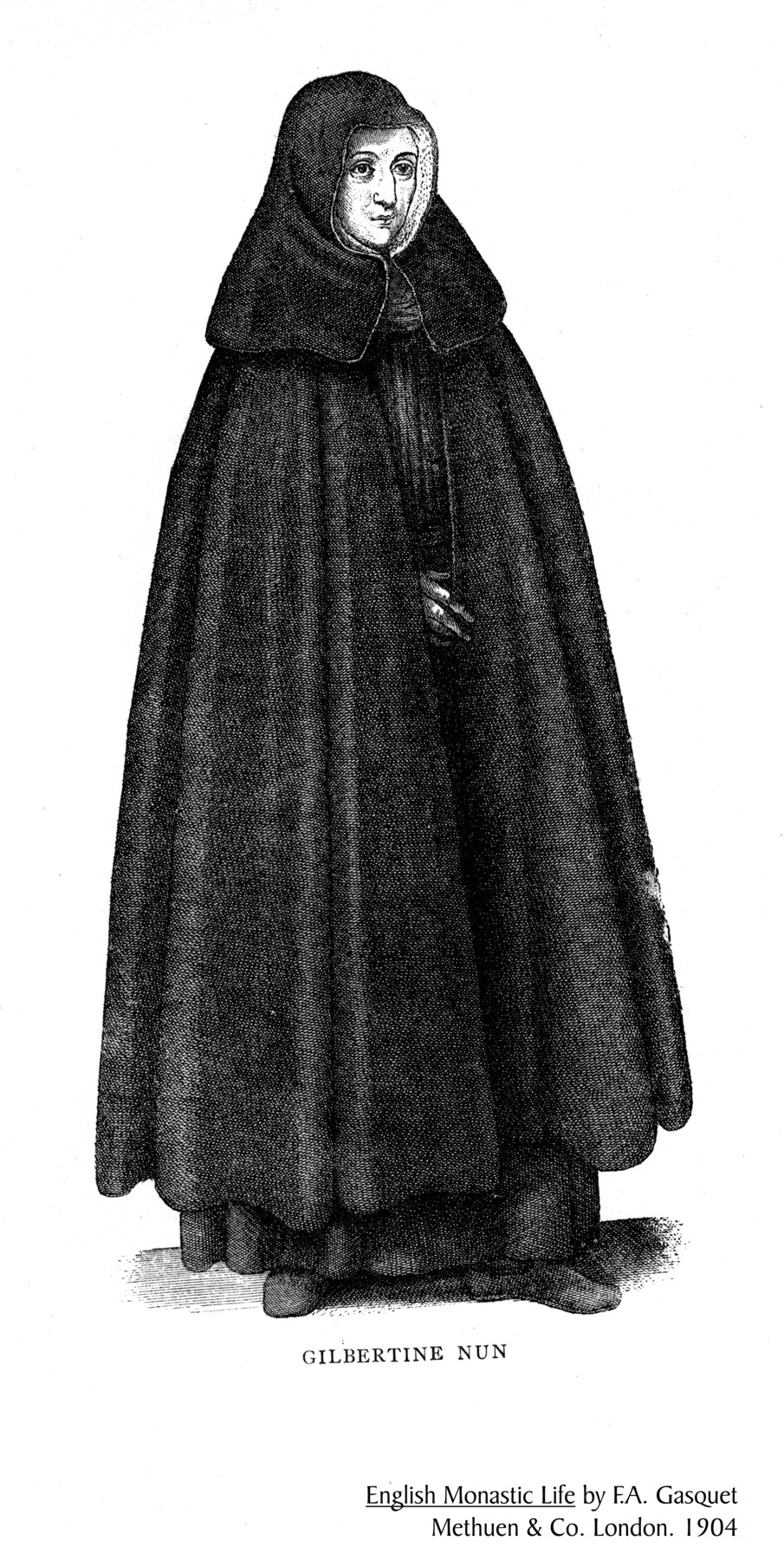
At the time of the forced closure of Harrold Priory (1536), it was was an all-woman community headed by a prioress. However, this was not the case in its early days. The documents relating to the foundation mention only 'canons', lay priests rather than monks and make no reference to women.  These men would have been responsible for the religious life of Harrold, centering on St Peter's Church.  According to the chronicles it was Hilbert Pelice, one of founder Samson le Fort's kinsmen, who persuaded him to found the priory, and who was early on given care of the church and new community.
A Gilbertine nun
Source: www.historyfish.net

The first prior, Guy, may have been brother to Abbot Gervase of Arrouaise, and he seems to have set up house with a monk referred to as 'B' in the chronicles.  The burgeoning community appears several times in historical documents in its first 30 years or so, where there are references to lay priests (canons), to brothers and to sisters (monks and nuns).  The names of two French nuns in Harrold, Jelita and Gila, appear early on, although it is made clear that the women's role is subservient to the men in the community.  It is not known if they were nuns (ordained) or lay sisters, although both went on in later years to become prioress at Harrold, so presumably would have become ordained.

By about 1188, though, when Harrold was fighting Arrouaise for its independence, the references are to the nuns of the community: canons and monks are no longer in the picture.  A mixed community would have been unusual, but by no means unique.  Indeed, Chicksands Priory which was both close by and a contemporary of Harrold, housed monks and nuns right up to the dissolution.  Chicksands was part of the Gilbertine order with many houses across England and Wales, mostly mixed sex.

The Arrouasian order, by contrast, all but disappeared in the later middle ages, and seems to have tolerated mixed houses at the time of Gervase.  The norm in religious life, though, was for strict segregation: it was felt that by having men and women together it created distractions which would impact poorly on contemplation and prayer.  Mixed sex communities also had the potential for scandal: it was reported that a Gilbertine nun at Watton in East Yorkshire in the mid 12th century was made pregnant by one of the community's lay brothers.
Porch at nearby Oakley church: the priest(s)
would originally live in the room above

In Harrold, meanwhile, the canons serving the churches of St Peters and the smaller church at Brayfield, seem to have moved out some time before 1188.  Often the priests would have been housed in a room over the church porch, but in Harrold there is no evidence of this as no porch survives.  There was a small thatched house which in the later middle ages came to be known as the vicarage, and which remains to this day in Church Walk.  This only starts to appear in the records in the 17th century, after the Priory had been dissolved.


Sources
  • Thompson, Sally (1991), Women religious: The founding of English nunneries after the Norman Conquest, Oxford: Clarendon Press
  • Venarde, Bruce L. (1997), Women's monasticism and medieval society: nunneries in France and England, 890-1215, Ithaca: Cornell University Press