Showing posts with label Bedford. Show all posts

Tuesday, 2 September 2014

Charity


The endowments and gifts provided by a nun's family when she joined the community would cover a fairly modest lifestyle.  The sums were also important to the maintenance of the buildings and to providing charity to all-comers.  For although nunneries and monasteries were largely closed communities, for centuries they fed the poor and tended to the sick.  They also provided shelter for travelers, all part of their vocation and implicit in the 'Rules' of St Benedict and (in Harrold's case) St Augustine.
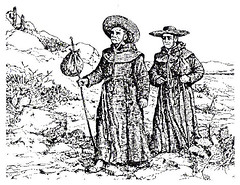
Pilgrims were a frequent sight on the roads
of medieval England, and would expect
hospitality from the religious houses they
passed by.
The nuns would have hoped and expected wealthy visitors to pay towards their keep, but they could not insist on this, and they could turn nobody away.  While many monastic communities were deliberately built in remote areas (like hermits, they would try and shut themselves away from the world), the Bedfordshire houses at Harrold, Elstow and Chicksands were all on busy medieval roads.

In the late 14th and early 15th centuries the nuns of Harrold had to plead poverty, citing their duty to "maintain great and expensive hospitality" through being close by the public road.  At this time one of the Bedford to Northampton roads passed through Pavenham and crossed the Great Ouse at Harrold bridge. According to the Viatores, at least some of this road was Roman in origin, and stretched back to Biggleswade. When it reached the Chellington and Carlton area it would have linked up with another former Roman road linking Wellingborough (a busy medieval market town), Irchester and Fenny Stratford on the old Watling Street in what is now Milton Keynes.  Apart from the wealthy, pilgrims and official travelers Harrold would have had to provide for the poor and homeless of the area for nearly four hundred years.

It is interesting to note that nearby Lavendon Abbey cited the same ruinous costs of providing hospitality to those coming along the high roads as a reason for financial hardship in the community. Although there were monastic communities at various time in Bedford, Northampton and Wellingborough, as well as in Lavendon, Harrold would have been the only provider of charity in a locality including Chellington, Carlton, Stevington, Odell and Sharnbrook.  With rich farmland and rising temperatures in the early medieval period, the population of this part of Bedfordshire boomed, with most of the local churches having to build new chapels and add aisles in the 13th and 14th centuries.  This growth stopped in about 1350 with the arrival of the Black Death.

Who was available to care for the sick at this time?  In the absence of any formal medical care it would have probably fallen to the nuns of Harrold Priory.   Chellington, just across the river from the priory, had been a busy and prosperous village up until this period, and there is speculation that the population was decimated by the Black Death or plague, with survivors moving to surrounding villages.


Sources
  • William Page (editor) (1912), A History of the County of Bedford: Volume 3, Victoria County History, pp.63-68
  • Power, Eileen (2010), Medieval English Nunneries: C1275 to 1535, Cambridge University Press
  • Viatores (1964), Roman roads in the south-east midlands, Victor Gollancz
  • 'House of Premonstratensian canons: The abbey of Lavendon', A History of the County of Buckingham: Volume 1 (1905), pp. 384-386. URL: http://www.british-history.ac.uk/report.aspx?compid=40317


Thursday, 21 August 2014

Nuns, priests and prioresses


Hall Close, Harrold today (source bedfordshire.gov.uk)
There are no visible archaeological remains of Harrold Priory.  After its successor Harrold Hall burned down in 1961 the estate was cleared and new exective homes were built in what is now Hall Close.  There appear to have been no archaeological excavations, although older local residents remember that what was called the dining hall had been used as stables and garaging.

It is likely that the old priory would have adjoined St Peter's church, or at least had a chamber attached where the nuns could take part in the services and receive communion from the canons, probably through a narrow window or other opening.  As a typical nunnery the community would consist of a head (in the case of Harrold the Prioress) and a maximum of 12 nuns (Venarde 1997).  The Gilbertines (such as those at nearby Chicksands) often had communities numbering into the hundreds, but these were exceptions.  Larger nunneries such as these would have had cloisters, but these are not mentioned in Harrold.

We have few traces of who lived and prayed at Harrold Priory, although in 1390 a Clerical Subsidy record was made which listed three chaplains to the house  - Robert Lary, William Yelden and Adam Seyyor.  They all had their own parishes (Lary is described as parson of both Stoke Goldington and Walton (a church now physically part of the Open University in Milton Keynes), and Seyyor of Great Brickhill (also adjoining modern Milton Keynes) in contemporary deeds.  Presumably they served as chaplain by rotation. At this time the women at the priory comprised the prioress and nine nuns, the latter being: Joan Causom; Joan Trokesforde; Elizabeth Bewmys; Leticia Tuttebyry; Margaret Wyks; Margaret Northwode; Emmota Drakelowe; Margaret Crouston; Emmota Wendylborogh.  Emmota (or Emma) Drakelowe went on to become prioress fourty years from 1394 and so must have been a relatively young woman at the time of the survey.  The other nuns and novices would have been from families of minor nobility, and the Clerical Subsidy would not have recorded the names of lay servants.

50 years later (1443) a visitation by the Bishop of Lincoln recorded a prioress and a sub-prioress and six nuns who were: Emma Welde; Alice Dekun; Agnes Grene; Agnes Tyringham; Thomasine Courteney; Grace Melton; Elizabeth Cotyngham.  Thomasine or Thomasina went on to become prioress.

Little more is said about the ordinary nuns until the end.  Thomas Cromwell's agent Dr. Layton reported in 1535 that there were at Harrold merely a prioress and four or five nuns, of whom one had 'two fair children' and another 'one child and no more'.

The Bedfordshire County History has extracted the names of many of the prioresses from the Harrold Cartulary in the British Museum. The list details where available the dates of election as Prioress, their resignation or merely the year when they are mentioned. Clearly the list is incomplete.  Further revision was made by Dr Herbert Fowler in 1935 as follows:
  • 1188: Gila - she came from the Arrouaisian priory of Maroueil near Arras;
  • c.1190-1210: Jelita or Julitta who came from the Arrouasian house in Boulogne;
  • 1227-1245: Agnes - she died in 1245;
  • 1245-1254: Basile Mauduit or Basile de la Lee or Legha, a nun from the priory instituted on the death of Agnes; daughter of Guntolda Mauduit, sister of Harrold landowner Ralph Morin;
  • 1262-1268: Amice;
  • c.1270: Juliana;
  • c.1270-1304: Margery of Hereford; she resigned in 1304; a serious scandal occurred under her rule;
  • 1304-1311: Cecily de Cancia; her election was at first declared void but was ultimately approved by the Bishop of Lincoln; she may have been daughter of Thomas de Kent or Cancia and Cecily de Birkin;
  • 1335-1354: Petronilla de Rydeware; her institution and resignation dates are all that is known of her;
  • 1354-1357: Cristiana Murdac or Murdak; a nun of the priory; she resigned in 1357;
  • 1357-1362: Matilda de Tichmersh;
  • 1367-1394: Katherine de Tutbury;
  • 1394-1434: Emma Drakelowe; a nun of the priory noted in the 1390 Clerical Subsidy;
  • 1440-1442: Alice Wautre or Wauter;
  • 1452: Thomasina Courtney; a nun of the priory appointed a vicar (though not able to administer the sacraments) of Harrold church on 15 Dec 1452 under the title "administrator of the priory and convent there" - which probably means she was the prioress;
  • 1464-1470: Elizabeth Chilteron or Chilton; she resigned in 1470;
  • 1470-1474: Margaret Pycard; a nun of the priory;
  • 1495-1501: Elena Crabbe; she died in 1501;
  • 1501-1509: Eleanor Pygot or Paget; she died in 1509;
  • 1509: Agnes Gascoigne or Gascony; a nun from "Shiphay" - if Sheppey is meant it is unusual as it was a Benedictine rather than an Augustinian house;
  • 1536; Eleanor Warren: prioress on the dissolution of the priory.


Sources


Thursday, 14 August 2014

Men or women? Priests, nuns and monks at Harrold


At the time of the forced closure of Harrold Priory (1536), it was was an all-woman community headed by a prioress. However, this was not the case in its early days. The documents relating to the foundation mention only 'canons', lay priests rather than monks and make no reference to women.  These men would have been responsible for the religious life of Harrold, centering on St Peter's Church.  According to the chronicles it was Hilbert Pelice, one of founder Samson le Fort's kinsmen, who persuaded him to found the priory, and who was early on given care of the church and new community.
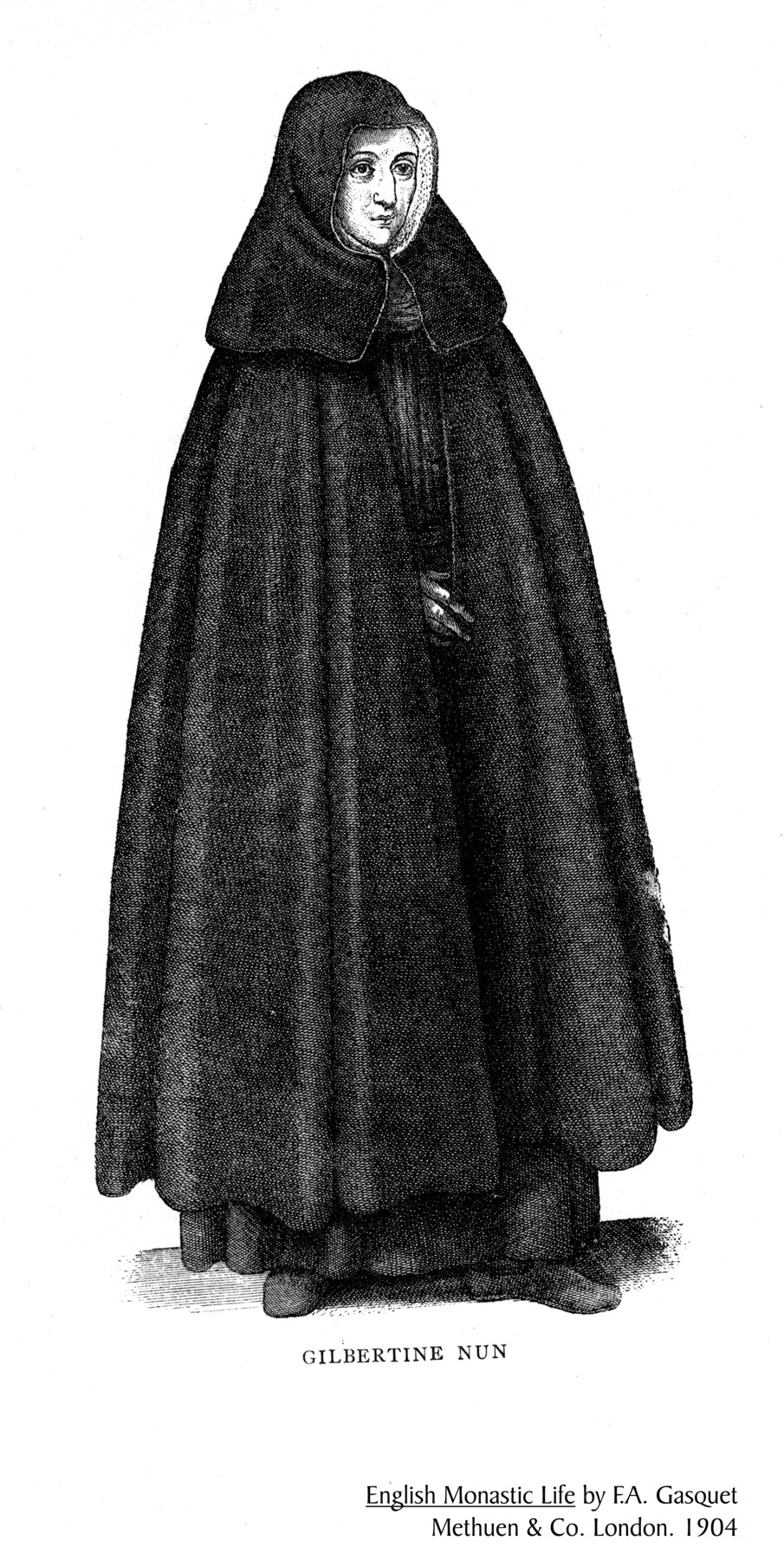
A Gilbertine nun
Source: www.historyfish.net

The first prior, Guy, may have been brother to Abbot Gervase of Arrouaise, and he seems to have set up house with a monk referred to as 'B' in the chronicles.  The burgeoning community appears several times in historical documents in its first 30 years or so, where there are references to lay priests (canons), to brothers and to sisters (monks and nuns).  The names of two French nuns in Harrold, Jelita and Gila, appear early on, although it is made clear that the women's role is subservient to the men in the community.  It is not known if they were nuns (ordained) or lay sisters, although both went on in later years to become prioress at Harrold, so presumably would have become ordained.

By about 1188, though, when Harrold was fighting Arrouaise for its independence, the references are to the nuns of the community: canons and monks are no longer in the picture.  A mixed community would have been unusual, but by no means unique.  Indeed, Chicksands Priory which was both close by and a contemporary of Harrold, housed monks and nuns right up to the dissolution.  Chicksands was part of the Gilbertine order with many houses across England and Wales, mostly mixed sex.

The Arrouasian order, by contrast, all but disappeared in the later middle ages, and seems to have tolerated mixed houses at the time of Gervase.  The norm in religious life, though, was for strict segregation: it was felt that by having men and women together it created distractions which would impact poorly on contemplation and prayer.  Mixed sex communities also had the potential for scandal: it was reported that a Gilbertine nun at Watton in East Yorkshire in the mid 12th century was made pregnant by one of the community's lay brothers.
Porch at nearby Oakley church: the priest(s)
would originally live in the room above

In Harrold, meanwhile, the canons serving the churches of St Peters and the smaller church at Brayfield, seem to have moved out some time before 1188.  Often the priests would have been housed in a room over the church porch, but in Harrold there is no evidence of this as no porch survives.  There was a small thatched house which in the later middle ages came to be known as the vicarage, and which remains to this day in Church Walk.  This only starts to appear in the records in the 17th century, after the Priory had been dissolved.


Sources
  • Thompson, Sally (1991), Women religious: The founding of English nunneries after the Norman Conquest, Oxford: Clarendon Press
  • Venarde, Bruce L. (1997), Women's monasticism and medieval society: nunneries in France and England, 890-1215, Ithaca: Cornell University Press

Tuesday, 12 August 2014

Introduction

Harrold Priory was a religious house serving the community of north Bedfordshire for nearly four hundred years.  The original establishment was shut down during the English reformation and the buildings sold for private use, and in time came to be known as Harrold Hall.  These were then rebuilt and extended over the following centuries until they burned down in 1961.

Harrold Hall in 1957 (Bedfordshire Community Archives)
Now nothing remains of the Priory apart from some isolated traces in the neighbouring St Peter's Church.  The site was redeveloped as executive housing.  Very few records remain apart from a 'cartulary' (a collection of historical legal documents) now in the British Museum.  These were translated in 1935 for the Bedfordshire Historical Society and form the basis of most of what is now known about the Priory.

In this blog we will draw on the cartulary and other sources to try and piece together a picture of Harrold Priory: who lived and worked there, what was its role, what problems did it face?

Harrold is a forgotten priory: it remained small and inconspicuous.  For most of its life it had very little wealth and few high profile patrons. Other similar houses in the region such as the nunneries at Elstow and Chicksands are better known and documented.  These pages aim to put a little more detail around Harrold Priory and the women who served there.

Soucres:

  • Dr.G.Herbert Fowler, Bedfordshire Historical Records Society volume 17 [1935]
  • Venarde, Bruce L. (1997), Women's monasticism and medieval society: nunneries in France and England, 890-1215, Ithaca: Cornell University Press
  • 'House of Austin nuns: The priory of Harrold', A History of the County of Bedford: Volume 1 (1904), pp. 387-390. URL: http://www.british-history.ac.uk/report.aspx?compid=40042 Date accessed: 21 August 2014.
  • Thompson, Sally (1991), Women religioius: The founding of English Nunneries after the Norman conquest, Oxford: Clarendon Press