Showing posts with label inheritance. Show all posts

Wednesday, 3 September 2014

Children at Harrold Priory


Harrold Priory may have taken in orphans, both during the plague years and at other times, and certainly took in children as boarders.  There is a record that in 1401-1402 the Priory received alms and gifts of 76 shillings and 8 pence, out of total income for the year of £60.  Further dontations in the accounts were for the boarding of three children at £7 and 10 shillings, of which £6 12s. 4d. was for the board of 'Lady de Ponynges', the daughter of Sir Reginald de Grey (Tillotson 1989).  De Grey was at the time being held hostage by Owain Glyndwr and the grant was made by his feoffee (trustee) Sir Gerard Braybrooke, who was the local Member of Parliament in this part of Bedfordshire and a generous patron of Harrold Priory.  Although Sir Reginald was eventually released (through the good offices of his friend Braybrooke), it may have been considered safest to keep his daughter Elizabeth Eleanor Grey (1393-1448) lodged in Harrold, far away from the fighting in Wales. Eleanor was only 8 or 9 at this time, although already married to Sir Robert Poynings.  The de Grey family continued to be patrons of St Peter's church, Harrold right up until recent years.

A child receives medical attention
British Library, MS 42130, f. 61r. Gallican Psalter 
(‘the Luttrell Psalter’,1325-1340)
Boys boarding at Harrold would have been moved to a monastery as soon as they were old enough.  When Bishop Alnwick visited Harrold in 1440, he set an upper age limit of 11 for boys and 12 for girls.  The Prioress, Dame Alice Decun confirmed that there were children living in the Priory at the time, two girls aged 6 or 7 who were sleeping in the nuns' dormitory (Power 2010).

A century later, at the dissolution in 1536, it was noted that there were three children living at Harrold Priory.  Dr Layton, the King's agent implied that the Priory had ceased to be in any real sense a religious house. He declared that he found there a prioress and four or five nuns, of whom one had 'two fair children' and another 'one child and no more'; (taken from The House of Austin Nuns 1904).

Layton was sneering about these children and made the assumption that these were the nuns' own offspring, the product of a dissolute lifestyle (the same assumptions were made about children living at the time in nearby Elstow Abbey).  It is likely, though, that children at Harrold and other nunneries were orphans or were otherwise being cared for as charity.  This would have been as natural to the nuns as caring for the sick or providing hospitality to travelers.  The children would probably also have received an education.


Sources
  • William Page (editor) (1912), A History of the County of Bedford: Volume 3, Victoria County History, pp.63-68
  • Power, Eileen (1922), Medieval English Nunneries: C1275 to 1535, Cambridge University Press
  • Tillotson, John H. (1989), Marrick Priory: A nunnery in late medieval Yorkshire, Borthwick Institute Publications.
  • 'House of Austin nuns: The priory of Harrold', A History of the County of Bedford: Volume 1 (1904), pp. 387-390.

Financial mismanagement and fraud


As holders of the 'livings' of the parishes of Harrold, Stevington and Brayfield, as well as other properties further afield, Harrold should have been well provided for materially. But as we have noted in an earlier blog, by the 15th century at least, poverty was a fact at the Priory.  In about 1402 they made their case for additional funds: not only was the cost of providing hospitality prohibitive, but "on account of the flooding of a certain great river called the Owse they very often suffered great losses; that its houses, buildings and inclosures were in a ruinous state, and that its fruits, &c were insufficient for such hospitality, for rebuilding and for other burdens..." (cited in the Victoria County History 1912).

How can this have happened?  Where did the money go?  There are three possible explanations: firstly the costs associated with these estates, particularly the churches; secondly financial mismanagement by successive Prioresses; and thirdly fraudulent or deceptive transactions carried out by the Priory's lay patrons.  At times the problems could have been a combination of all three.

St Mary's, Stevington. The various additions of the middle
ages are clearly seen, including chapels which were later
abandoned.  Harrold Priory would have paid for these changes
The 'livings' of the parishes listed above brought income, certainly, but they also brought costs.  The Priory would be responsible for the stipends (salaries) of the cannons (priests) at Harrold, Stevington and Brayfield, and they would also have had to pay for building and maintenance.  The 12th,13th and early 14th centuries saw a more than doubling of the population in Bedfordshire, particularly in rural areas.  The churches were forced to adapt their buildings, and Harrold and Stevington in particular added new aisles, chapels and windows to accommodate the increased numbers of worshipers.  Each of the churches added or enlarged towers during this period, with St Peter's at Harrold building the elegant spire we still see today.

There were other costs associated with the Priory's role: for example the bridge and causeway across the Great Ouse at Harrold was built and maintained jointly by the manors of  Odell, Carlton and Chellington and Harrold Priory.   It may be that in more experienced hands these costs and transactions would have been managed well, but Harrold Priory, it seems, did not always have capable leaders.  Things would certainly have been much more difficult after the arrival of the Black Death in 1348: the revenues of all landowners including the communities at Harrold and Lavendon, were squeezed as labourers died and the survivors demanded better pay for their services.  Many tenant farms lay uncultivated for generations: rentals dropped or dried up altogether and it was another 400 years before the population levels had recovered.

In 1442-1443 Bishop Alnwick of Lincoln complained that the Prioress of Harrold non reddidit compotum, meaning that she had not submitted annual accounts.  Indeed it seemed that she kept no records at all of transactions and had therefore been compromised when tradespeople demanded double the payment for goods or services than had been agreed.  As well as other shortcomings, the Bishop noted that the Prioress had sold a corrody (a lifetime's allowance of shelter, food and drink) for 20 marks, presumably far less than it cost to provide.  She was also rebuked for allowing woodland belonging to the Priory to be cut down, timber being a highly valued resource for building and for firewood.

At the time of the Bishop's visit, Harrold was in debt to the tune of 20 marks (13 pounds 12 shillings and 8 pence), a substantial amount equivalent to several months of rental income, but by no means the highest level of debt in the diocese.  But the Bishop singled out Harrold and stipulated in detail the type of agreements for which the Prioress was required to gain prior approval from Lincoln - contracts, grants of land, pensions, annuities, etc.  To make it clear, he told her that she and her successors must agree to this arrangement "vnder the payne of priouacyone" (Power, 2010, p.226).  All of this suggests that there was little attention being paid to these things and that the Priory's estates were being whittled away.

There was also the suggestion that some of the Priory's patrons were advising the nuns, not in the interests of the community but to the patrons' benefit.  This included the Priory selling or making grants of land or other property to local landowners at below market rates.  The Bishop's representatives also believed that the nuns had been fraudulently deceived in some cases and had signed documents written in latin without having any idea what they were giving assent to.

Interestingly, the same accusations were made in 1536 by the King's commissioner Dr Layton when he reported to Thomas Cromwell prior to the closure of Harrold Priory. Layton describes how "Lord Mordaunt had induced the prioress and her 'foolish young flock' to break open the coffer containing the charters of the priory, and to seal a writing in Latin of which they did not understand a word, but were told it was merely the lease of an impropriate benefice. 'All say they durst not say him nay,' he adds; 'and the prioress saith plainly that she would never consent thereto.'" (taken from A History of the County of Bedford, Volume 1).   Lord Mordaunt's ancestral seat was in nearby Turvey.  As the History's author notes, there is no actual evidence against the patron, "But unhappily there is nothing at all improbable in the story of Lord Mordaunt and the charters. The patron of a house so small and so poor would be in a position to take a very high hand with the little convent, especially as one or two of the nuns would very likely be members of his own family."

It is sad to reflect that Harrold Priory, for all its lands and buildings, should have been reduced to a state of poverty by a combination of misfortunes and mismanagement. Proper care and attention would have allowed it to continue its work in the Harrold community, providing for travelers, feeding the poor and caring for the sick.  At least there is a legacy in the fine church buildings at Stevington, Cold Brayfield and Harrold.


Sources
  • Power, Eileen (2010), Medieval English Nunneries: C1275 to 1535, Cambridge University Press
  • Spear, Valerie (2005), Leadership in Medieval English Nunneries, Boydell Press.
  • 'House of Austin nuns: The priory of Harrold', A History of the County of Bedford: Volume 1 (1904), pp. 387-390.  http://www.british-history.ac.uk/report.aspx?compid=40042
  • 'Parishes: Harrold', A History of the County of Bedford: Volume 3 (1912), pp. 63-68. URL: http://www.british-history.ac.uk/report.aspx?compid=42384 
  • 'House of Premonstratensian canons: The abbey of Lavendon', A History of the County of Buckingham: Volume 1 (1905), pp. 384-386. URL: http://www.british-history.ac.uk/report.aspx?compid=40317


Saturday, 16 August 2014

The Community of Harrold


The middle ages in Europe witnessed a massive expansion in the number of monastic institutions for women. Bruce Verande's study of the phenomenon shows that England was no exception, and Samson le Fort's foundation was just one of dozens made in the aftermath of the Norman conquest.  Including Harrold, 114 new nunneries were established in England in the period 1126 to 1200. There were 5 other women's houses founded in the area in the late 11th century and 12th, including the well known Bedfordshire communities of Chicksands (1150) and Elstow (1078).  It is worth noting, of course, that there were far more communities for men founded at this time, around a hundred or so (Verande 1997).

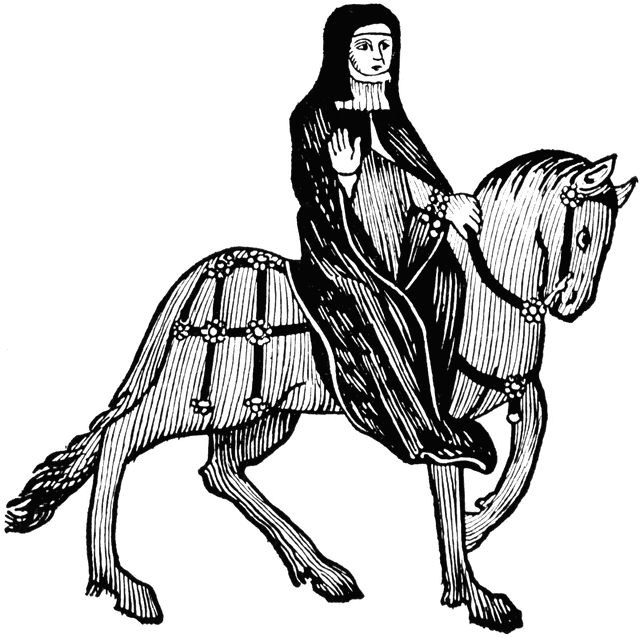
The Prioress, from Chaucer's Canterbury Tales
We know almost nothing about the women who joined the Harrold community, apart from some isolated names (mostly the prioresses).  Two of the original members, Jelita and Gila came to Harrold from the mother community at Arouaise near Calais. In the early years of the Priory, most of nuns would have been from Anglo-Norman ruling families.  Nunneries, like the male counterparts, were mostly populated by the families of the landed classes.

The nuns of Harrold would have been wives and daughters from wealthy families.  The attraction for many women would have been spiritual: they would have looked forward to a life of contemplation and prayer, shut away from the concerns and stresses of the material world.  Such a life, though, came at a price and their families would have been expected to contribute to the cost of their upkeep through grants of land, money or goods.

Nunneries were given an additional impetus by Norman inheritance practices and the norms of medieval society. Unless a woman married her place in society as an adult was vulnerable: she had no way of earning her own living and maintaining herself, and would only rarely inherit sufficient from her family to live independently. Inheritance laws meant that when her father died a woman's brother or male heir would take over the family home and invariably she would no longer have a place in the household.  A place in a nunnery would mean that she was provided for in a safe place.

Similar considerations often applied when it came to widows, many of whom would have been unable to re-marry and would have ended their days in a place like Harrold Priory rather than in a son's extended household.  There are also examples of women escaping a difficult marriage or prospect of one by entering a convent (Venarde 1997).  Some community leaders such as Robert of Arbrissel were prepared to defy church authorities and give such women protection from their estranged husbands and the law.

Indeed in some cases in the middle ages it appears that by forcing their wives into nunneries powerful men were able to renounce their first wives and re-marry.  On occasion men would cite new concerns about consanguinity and incest to have first marriages annulled and their former wives consigned to nunneries, leaving them free to make new, politically advantageous marriages elsewhere.  To make things worse for women (in England at least) aristocratic widows and orphans often became the 'property' of the king, to dispose of at will or to the highest bidder: Henry II of England, for example, 'owned' 80 widows in this position. The temptation would have often to have been to take oneself out of such servitude and into a nunnery.  According to Venarde a typical community of the time would have been made up of 35% of inmates who were described as widows, wives, mothers or grandmothers.  It seems possible that "massive numbers of women [were] being thrust willy nilly into the cloister by (usually) male relatives eager to rid themselves of the responsibility for caring for them and in some cases to come into control of the women's property" (Venarde 11997, p.101).

With so many hundreds of young men from landed families joining monasteries each year, combined with the effect of the almost continual wars of the middle ages, the pool of marriageable young men was always going to be smaller than the available women - although the high levels of mortality in childbirth did something to redress this imbalance.   For those women unable or unwilling to marry life as a nun offered an alternative. An example of this would be Hertfordshire's Christina of Markyate who escaped the attentions of would-be suitors and lovers by hiding and devoting herself to a life of prayer. Many others, like Christina, were given no choice.  Convents were also known to take children, for example orphans, and provide for them.  They would also accept women who were sick and take care of them (Thompson 1991).

Harrold Priory, like others, would have had more than ordained nuns.  There would have been novices who were working towards ordination, as well as number of lay sisters who were generally uneducated, from poorer families, whose role would be as servants, preparing food, cleaning, providing for guests, etc.  There would likely have been male and female paid servants also, for example.

The nuns themselves would more than likely have been literate and would have managed in Norman French (or later, English) as well as Latin.


Sources
  • Venarde, Bruce L. (1997), Women's monasticism and medieval society: nunneries in France and England, 890-1215, Ithaca: Cornell University Press
  • Thompson, Sally (1991), Women religioius: The founding of English Nunneries after the Norman conquest, Oxford: Clarendon Press