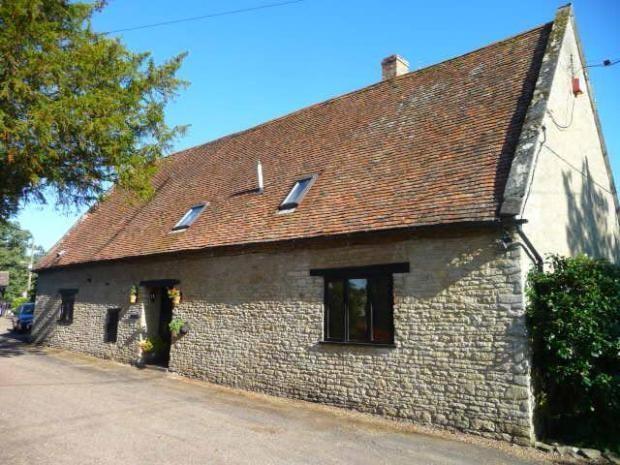
As holders of the 'livings' of the parishes of Harrold, Stevington and Brayfield, as well as other properties further afield, Harrold should have been well provided for materially. But as we have noted in an earlier blog, by the 15th century at least, poverty was a fact at the Priory. In about 1402 they made their case for additional funds: not only was the cost of providing hospitality prohibitive, but "on account of the flooding of a certain great river called the Owse they very often suffered great losses; that its houses, buildings and inclosures were in a ruinous state, and that its fruits, &c were insufficient for such hospitality, for rebuilding and for other burdens..." (cited in the Victoria County History 1912).
How can this have happened? Where did the money go? There are three possible explanations: firstly the costs associated with these estates, particularly the churches; secondly financial mismanagement by successive Prioresses; and thirdly fraudulent or deceptive transactions carried out by the Priory's lay patrons. At times the problems could have been a combination of all three.
 |
| St Mary's, Stevington. The various additions of the middle ages are clearly seen, including chapels which were later abandoned. Harrold Priory would have paid for these changes |
There were other costs associated with the Priory's role: for example the bridge and causeway across the Great Ouse at Harrold was built and maintained jointly by the manors of Odell, Carlton and Chellington and Harrold Priory. It may be that in more experienced hands these costs and transactions would have been managed well, but Harrold Priory, it seems, did not always have capable leaders. Things would certainly have been much more difficult after the arrival of the Black Death in 1348: the revenues of all landowners including the communities at Harrold and Lavendon, were squeezed as labourers died and the survivors demanded better pay for their services. Many tenant farms lay uncultivated for generations: rentals dropped or dried up altogether and it was another 400 years before the population levels had recovered.
In 1442-1443 Bishop Alnwick of Lincoln complained that the Prioress of Harrold non reddidit compotum, meaning that she had not submitted annual accounts. Indeed it seemed that she kept no records at all of transactions and had therefore been compromised when tradespeople demanded double the payment for goods or services than had been agreed. As well as other shortcomings, the Bishop noted that the Prioress had sold a corrody (a lifetime's allowance of shelter, food and drink) for 20 marks, presumably far less than it cost to provide. She was also rebuked for allowing woodland belonging to the Priory to be cut down, timber being a highly valued resource for building and for firewood.
At the time of the Bishop's visit, Harrold was in debt to the tune of 20 marks (13 pounds 12 shillings and 8 pence), a substantial amount equivalent to several months of rental income, but by no means the highest level of debt in the diocese. But the Bishop singled out Harrold and stipulated in detail the type of agreements for which the Prioress was required to gain prior approval from Lincoln - contracts, grants of land, pensions, annuities, etc. To make it clear, he told her that she and her successors must agree to this arrangement "vnder the payne of priouacyone" (Power, 2010, p.226). All of this suggests that there was little attention being paid to these things and that the Priory's estates were being whittled away.
There was also the suggestion that some of the Priory's patrons were advising the nuns, not in the interests of the community but to the patrons' benefit. This included the Priory selling or making grants of land or other property to local landowners at below market rates. The Bishop's representatives also believed that the nuns had been fraudulently deceived in some cases and had signed documents written in latin without having any idea what they were giving assent to.
Interestingly, the same accusations were made in 1536 by the King's commissioner Dr Layton when he reported to Thomas Cromwell prior to the closure of Harrold Priory. Layton describes how "Lord Mordaunt had induced the prioress and her 'foolish young flock' to break open the coffer containing the charters of the priory, and to seal a writing in Latin of which they did not understand a word, but were told it was merely the lease of an impropriate benefice. 'All say they durst not say him nay,' he adds; 'and the prioress saith plainly that she would never consent thereto.'" (taken from A History of the County of Bedford, Volume 1). Lord Mordaunt's ancestral seat was in nearby Turvey. As the History's author notes, there is no actual evidence against the patron, "But unhappily there is nothing at all improbable in the story of Lord Mordaunt and the charters. The patron of a house so small and so poor would be in a position to take a very high hand with the little convent, especially as one or two of the nuns would very likely be members of his own family."
It is sad to reflect that Harrold Priory, for all its lands and buildings, should have been reduced to a state of poverty by a combination of misfortunes and mismanagement. Proper care and attention would have allowed it to continue its work in the Harrold community, providing for travelers, feeding the poor and caring for the sick. At least there is a legacy in the fine church buildings at Stevington, Cold Brayfield and Harrold.
Sources
- Power, Eileen (2010), Medieval English Nunneries: C1275 to 1535, Cambridge University Press
- Spear, Valerie (2005), Leadership in Medieval English Nunneries, Boydell Press.
- 'House of Austin nuns: The priory of Harrold', A History of the County of Bedford: Volume 1 (1904), pp. 387-390. http://www.british-history.ac.uk/report.aspx?compid=40042
- 'Parishes: Harrold', A History of the County of Bedford: Volume 3 (1912), pp. 63-68. URL: http://www.british-history.ac.uk/report.aspx?compid=42384
- 'House of Premonstratensian canons: The abbey of Lavendon', A History of the County of Buckingham: Volume 1 (1905), pp. 384-386. URL: http://www.british-history.ac.uk/report.aspx?compid=40317