Showing posts with label Jelita. Show all posts

Thursday, 21 August 2014

Nuns, priests and prioresses


Hall Close, Harrold today (source bedfordshire.gov.uk)
There are no visible archaeological remains of Harrold Priory.  After its successor Harrold Hall burned down in 1961 the estate was cleared and new exective homes were built in what is now Hall Close.  There appear to have been no archaeological excavations, although older local residents remember that what was called the dining hall had been used as stables and garaging.

It is likely that the old priory would have adjoined St Peter's church, or at least had a chamber attached where the nuns could take part in the services and receive communion from the canons, probably through a narrow window or other opening.  As a typical nunnery the community would consist of a head (in the case of Harrold the Prioress) and a maximum of 12 nuns (Venarde 1997).  The Gilbertines (such as those at nearby Chicksands) often had communities numbering into the hundreds, but these were exceptions.  Larger nunneries such as these would have had cloisters, but these are not mentioned in Harrold.

We have few traces of who lived and prayed at Harrold Priory, although in 1390 a Clerical Subsidy record was made which listed three chaplains to the house  - Robert Lary, William Yelden and Adam Seyyor.  They all had their own parishes (Lary is described as parson of both Stoke Goldington and Walton (a church now physically part of the Open University in Milton Keynes), and Seyyor of Great Brickhill (also adjoining modern Milton Keynes) in contemporary deeds.  Presumably they served as chaplain by rotation. At this time the women at the priory comprised the prioress and nine nuns, the latter being: Joan Causom; Joan Trokesforde; Elizabeth Bewmys; Leticia Tuttebyry; Margaret Wyks; Margaret Northwode; Emmota Drakelowe; Margaret Crouston; Emmota Wendylborogh.  Emmota (or Emma) Drakelowe went on to become prioress fourty years from 1394 and so must have been a relatively young woman at the time of the survey.  The other nuns and novices would have been from families of minor nobility, and the Clerical Subsidy would not have recorded the names of lay servants.

50 years later (1443) a visitation by the Bishop of Lincoln recorded a prioress and a sub-prioress and six nuns who were: Emma Welde; Alice Dekun; Agnes Grene; Agnes Tyringham; Thomasine Courteney; Grace Melton; Elizabeth Cotyngham.  Thomasine or Thomasina went on to become prioress.

Little more is said about the ordinary nuns until the end.  Thomas Cromwell's agent Dr. Layton reported in 1535 that there were at Harrold merely a prioress and four or five nuns, of whom one had 'two fair children' and another 'one child and no more'.

The Bedfordshire County History has extracted the names of many of the prioresses from the Harrold Cartulary in the British Museum. The list details where available the dates of election as Prioress, their resignation or merely the year when they are mentioned. Clearly the list is incomplete.  Further revision was made by Dr Herbert Fowler in 1935 as follows:
  • 1188: Gila - she came from the Arrouaisian priory of Maroueil near Arras;
  • c.1190-1210: Jelita or Julitta who came from the Arrouasian house in Boulogne;
  • 1227-1245: Agnes - she died in 1245;
  • 1245-1254: Basile Mauduit or Basile de la Lee or Legha, a nun from the priory instituted on the death of Agnes; daughter of Guntolda Mauduit, sister of Harrold landowner Ralph Morin;
  • 1262-1268: Amice;
  • c.1270: Juliana;
  • c.1270-1304: Margery of Hereford; she resigned in 1304; a serious scandal occurred under her rule;
  • 1304-1311: Cecily de Cancia; her election was at first declared void but was ultimately approved by the Bishop of Lincoln; she may have been daughter of Thomas de Kent or Cancia and Cecily de Birkin;
  • 1335-1354: Petronilla de Rydeware; her institution and resignation dates are all that is known of her;
  • 1354-1357: Cristiana Murdac or Murdak; a nun of the priory; she resigned in 1357;
  • 1357-1362: Matilda de Tichmersh;
  • 1367-1394: Katherine de Tutbury;
  • 1394-1434: Emma Drakelowe; a nun of the priory noted in the 1390 Clerical Subsidy;
  • 1440-1442: Alice Wautre or Wauter;
  • 1452: Thomasina Courtney; a nun of the priory appointed a vicar (though not able to administer the sacraments) of Harrold church on 15 Dec 1452 under the title "administrator of the priory and convent there" - which probably means she was the prioress;
  • 1464-1470: Elizabeth Chilteron or Chilton; she resigned in 1470;
  • 1470-1474: Margaret Pycard; a nun of the priory;
  • 1495-1501: Elena Crabbe; she died in 1501;
  • 1501-1509: Eleanor Pygot or Paget; she died in 1509;
  • 1509: Agnes Gascoigne or Gascony; a nun from "Shiphay" - if Sheppey is meant it is unusual as it was a Benedictine rather than an Augustinian house;
  • 1536; Eleanor Warren: prioress on the dissolution of the priory.


Sources


Saturday, 16 August 2014

The Community of Harrold


The middle ages in Europe witnessed a massive expansion in the number of monastic institutions for women. Bruce Verande's study of the phenomenon shows that England was no exception, and Samson le Fort's foundation was just one of dozens made in the aftermath of the Norman conquest.  Including Harrold, 114 new nunneries were established in England in the period 1126 to 1200. There were 5 other women's houses founded in the area in the late 11th century and 12th, including the well known Bedfordshire communities of Chicksands (1150) and Elstow (1078).  It is worth noting, of course, that there were far more communities for men founded at this time, around a hundred or so (Verande 1997).

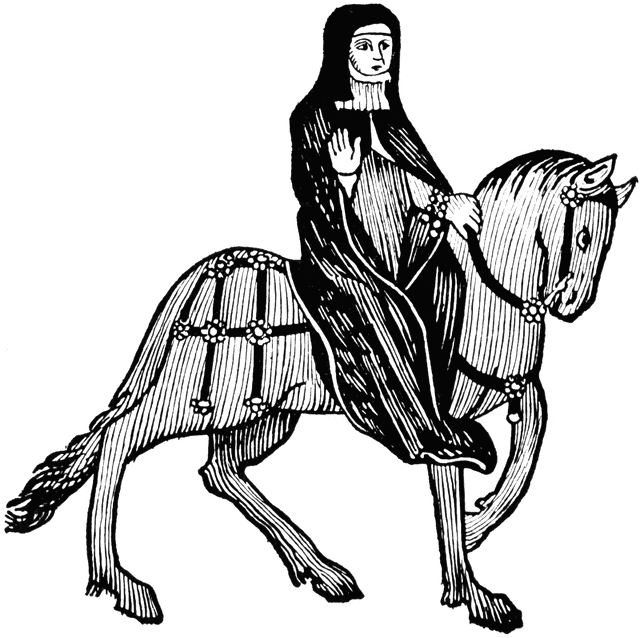
The Prioress, from Chaucer's Canterbury Tales
We know almost nothing about the women who joined the Harrold community, apart from some isolated names (mostly the prioresses).  Two of the original members, Jelita and Gila came to Harrold from the mother community at Arouaise near Calais. In the early years of the Priory, most of nuns would have been from Anglo-Norman ruling families.  Nunneries, like the male counterparts, were mostly populated by the families of the landed classes.

The nuns of Harrold would have been wives and daughters from wealthy families.  The attraction for many women would have been spiritual: they would have looked forward to a life of contemplation and prayer, shut away from the concerns and stresses of the material world.  Such a life, though, came at a price and their families would have been expected to contribute to the cost of their upkeep through grants of land, money or goods.

Nunneries were given an additional impetus by Norman inheritance practices and the norms of medieval society. Unless a woman married her place in society as an adult was vulnerable: she had no way of earning her own living and maintaining herself, and would only rarely inherit sufficient from her family to live independently. Inheritance laws meant that when her father died a woman's brother or male heir would take over the family home and invariably she would no longer have a place in the household.  A place in a nunnery would mean that she was provided for in a safe place.

Similar considerations often applied when it came to widows, many of whom would have been unable to re-marry and would have ended their days in a place like Harrold Priory rather than in a son's extended household.  There are also examples of women escaping a difficult marriage or prospect of one by entering a convent (Venarde 1997).  Some community leaders such as Robert of Arbrissel were prepared to defy church authorities and give such women protection from their estranged husbands and the law.

Indeed in some cases in the middle ages it appears that by forcing their wives into nunneries powerful men were able to renounce their first wives and re-marry.  On occasion men would cite new concerns about consanguinity and incest to have first marriages annulled and their former wives consigned to nunneries, leaving them free to make new, politically advantageous marriages elsewhere.  To make things worse for women (in England at least) aristocratic widows and orphans often became the 'property' of the king, to dispose of at will or to the highest bidder: Henry II of England, for example, 'owned' 80 widows in this position. The temptation would have often to have been to take oneself out of such servitude and into a nunnery.  According to Venarde a typical community of the time would have been made up of 35% of inmates who were described as widows, wives, mothers or grandmothers.  It seems possible that "massive numbers of women [were] being thrust willy nilly into the cloister by (usually) male relatives eager to rid themselves of the responsibility for caring for them and in some cases to come into control of the women's property" (Venarde 11997, p.101).

With so many hundreds of young men from landed families joining monasteries each year, combined with the effect of the almost continual wars of the middle ages, the pool of marriageable young men was always going to be smaller than the available women - although the high levels of mortality in childbirth did something to redress this imbalance.   For those women unable or unwilling to marry life as a nun offered an alternative. An example of this would be Hertfordshire's Christina of Markyate who escaped the attentions of would-be suitors and lovers by hiding and devoting herself to a life of prayer. Many others, like Christina, were given no choice.  Convents were also known to take children, for example orphans, and provide for them.  They would also accept women who were sick and take care of them (Thompson 1991).

Harrold Priory, like others, would have had more than ordained nuns.  There would have been novices who were working towards ordination, as well as number of lay sisters who were generally uneducated, from poorer families, whose role would be as servants, preparing food, cleaning, providing for guests, etc.  There would likely have been male and female paid servants also, for example.

The nuns themselves would more than likely have been literate and would have managed in Norman French (or later, English) as well as Latin.


Sources
  • Venarde, Bruce L. (1997), Women's monasticism and medieval society: nunneries in France and England, 890-1215, Ithaca: Cornell University Press
  • Thompson, Sally (1991), Women religioius: The founding of English Nunneries after the Norman conquest, Oxford: Clarendon Press