Showing posts with label Norman. Show all posts

Wednesday, 20 August 2014

Chastity, celibacy and virginity


A woman joining the religious community at Harrold in the middle ages would have had to have made vows of celibacy and chastity.  While the first meant that she would renounce marriage (a nun was considered to be 'the bride of Christ' and wore a ring to mark this fact), the second meant in practice a life of sexual abstinence.

Virginity was a more complex virtue, as many women joining the community would not have been virgins in the strict sense.   There were many widows, as well as younger women who were unmarried mothers.  Indeed in the history of the medieval church, some of the most successful and well known nuns have been figures such as Petronille de Chemillé and Héloïse d'Argenteuil who were in this category, and yet went on to become abbesses of important communities.  As Martyn Whittock has noted, though, in this period virginity was seen as something which could be 'recovered', in a sense, through a life of repentance, prayer, celibacy and chastity.

Bishop Grosseteste: Harrold Priory was
governed by the bishops of Lincoln
Given the varied motivations of women joining a community like Harrold, it is perhaps unsurprising that here and elsewhere there would be occasional transgressions.  In 1298, for example, one of Harrold's nuns was found to have breached her vows of chastity (Power 1010).  Her lover was sentenced by a church court, to be beaten in the market place, but refused to submit to the punishment and so was excommunicated (excluded from the rites of the church).  In 1311 the bishop of Lincoln, who had oversight over the Harrold community, appointed a commission to investigate and correct wrongdoing here and at other unspecified communities.  It is not know what these alleged misdeeds were as no record of the 'visitation' remains.

However, this was by no means unusual.  In a celebrated case a century before, in about 1166, it was reported that a nun from the Gilbertine house at Watton in East Yorkshire had become pregnant by one of the lay brothers of the house: in this case he was apprehended and was said to have been castrated by the nuns.  This and other alleged scandals led to the whole order coming under the scrutiny of the church under the direction of Pope Alexander III.  While the problem was said to be sexual licence within the order, the investigation focused more on dissatisfaction among the lay brothers about working conditions.

Similarly, in 1177 Henry II of England expelled the Anglo-Saxon nuns of Amesbury and replaced them with 24 nuns from Fontevraud.  He cited instances of moral laxity on the part of the English sisters, whom he claimed were debauched (the abbess was said to have been the mother of three children).    And some time in the 1190s Gerald of Wales wrote of the lust of a Gilbertine for her aged master.  These reported happenings were commonplace in fiction at the time: Giovanni Bocaccio's Decameron (1353) contains tales of sexual licence set in nunneries.

Elstow Abbey, less than a day away from Harrold on foot, was frequently the subject of the Bishops' scrutiny, Lincoln's Bishop Gravesend referring in 1260 to "disgraceful acts" which he said were "'from that house more frequently than from any other".  In 1369 the bishop complained that the nuns of Elstow were "wandering" out of the community far too much.  Moreover, many of Elstow's nuns were from artistocratic families and had regular visitors of family and friends (noble ladies and even queens) from their previous lives.  By 1379 Bishop Buckingham was having to instruct the nuns of Elstow not to talk to men at all, not to leave the house without permission and to be back before sunset.  The fact that he had to remind them that they should not be wearing fur or jewelry suggests that the nuns were interpreting the rules of dress rather too liberally for the church's liking.  

In 14th century Harrold, though, the problems did not seem to want to go away, and in 1369 Bishop Glynwell of Lincoln appointed Dame Katherine of Tutbury to reform the excesses of the Priory during a period when there was no prioress. As the County History notes, from the cartularly records little more is said until the priory was visited in 1535 by Thomas Cromwell's agent Dr Layton.  He reported that there were just four or five nuns and a prioress, two of whom had children.  Once again, though, this kind of allegation was commonly being made at the time, and as with Henry II they may have been motivated by a desire to discredit the community for other purposes.


Sources

  • Elkins, Sharon (1988), Holy women of 12th century England, Chapel Hill: University of North Carolina
  • Venarde, Bruce L. (1997), Women's monasticism and medieval society: nunneries in France and England, 890-1215, Ithaca: Cornell University Press
  • Brewer, J.S. (ed), (1862), Gerald of Wales Gemma Ecclesiastica
  • Whittock, Martyn (2009), A brief history of life in the middle ages, London: Constable & Robinson
  • 'Houses of Benedictine nuns: The abbey of Elstow', A History of the County of Bedford: Volume 1 (1904), pp. 353-358. 
  • Power, Eileen (2010), Medieval English Nunneries: C1275 to 1535, Cambridge University Press


Saturday, 16 August 2014

The Community of Harrold


The middle ages in Europe witnessed a massive expansion in the number of monastic institutions for women. Bruce Verande's study of the phenomenon shows that England was no exception, and Samson le Fort's foundation was just one of dozens made in the aftermath of the Norman conquest.  Including Harrold, 114 new nunneries were established in England in the period 1126 to 1200. There were 5 other women's houses founded in the area in the late 11th century and 12th, including the well known Bedfordshire communities of Chicksands (1150) and Elstow (1078).  It is worth noting, of course, that there were far more communities for men founded at this time, around a hundred or so (Verande 1997).

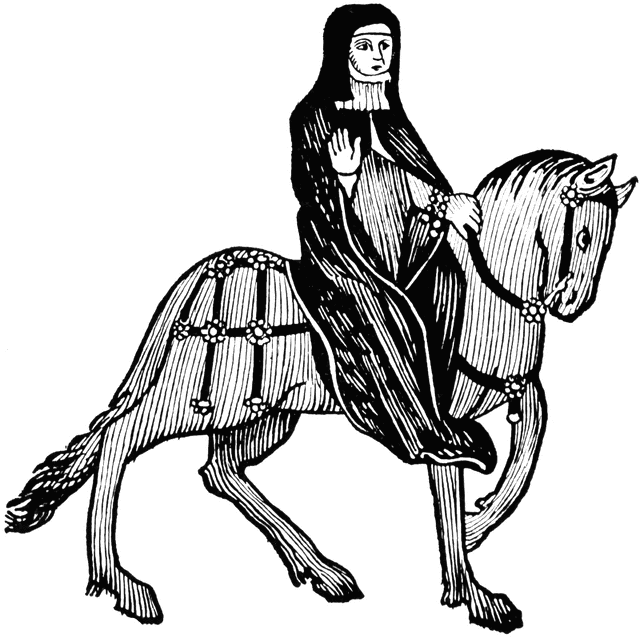
The Prioress, from Chaucer's Canterbury Tales
We know almost nothing about the women who joined the Harrold community, apart from some isolated names (mostly the prioresses).  Two of the original members, Jelita and Gila came to Harrold from the mother community at Arouaise near Calais. In the early years of the Priory, most of nuns would have been from Anglo-Norman ruling families.  Nunneries, like the male counterparts, were mostly populated by the families of the landed classes.

The nuns of Harrold would have been wives and daughters from wealthy families.  The attraction for many women would have been spiritual: they would have looked forward to a life of contemplation and prayer, shut away from the concerns and stresses of the material world.  Such a life, though, came at a price and their families would have been expected to contribute to the cost of their upkeep through grants of land, money or goods.

Nunneries were given an additional impetus by Norman inheritance practices and the norms of medieval society. Unless a woman married her place in society as an adult was vulnerable: she had no way of earning her own living and maintaining herself, and would only rarely inherit sufficient from her family to live independently. Inheritance laws meant that when her father died a woman's brother or male heir would take over the family home and invariably she would no longer have a place in the household.  A place in a nunnery would mean that she was provided for in a safe place.

Similar considerations often applied when it came to widows, many of whom would have been unable to re-marry and would have ended their days in a place like Harrold Priory rather than in a son's extended household.  There are also examples of women escaping a difficult marriage or prospect of one by entering a convent (Venarde 1997).  Some community leaders such as Robert of Arbrissel were prepared to defy church authorities and give such women protection from their estranged husbands and the law.

Indeed in some cases in the middle ages it appears that by forcing their wives into nunneries powerful men were able to renounce their first wives and re-marry.  On occasion men would cite new concerns about consanguinity and incest to have first marriages annulled and their former wives consigned to nunneries, leaving them free to make new, politically advantageous marriages elsewhere.  To make things worse for women (in England at least) aristocratic widows and orphans often became the 'property' of the king, to dispose of at will or to the highest bidder: Henry II of England, for example, 'owned' 80 widows in this position. The temptation would have often to have been to take oneself out of such servitude and into a nunnery.  According to Venarde a typical community of the time would have been made up of 35% of inmates who were described as widows, wives, mothers or grandmothers.  It seems possible that "massive numbers of women [were] being thrust willy nilly into the cloister by (usually) male relatives eager to rid themselves of the responsibility for caring for them and in some cases to come into control of the women's property" (Venarde 11997, p.101).

With so many hundreds of young men from landed families joining monasteries each year, combined with the effect of the almost continual wars of the middle ages, the pool of marriageable young men was always going to be smaller than the available women - although the high levels of mortality in childbirth did something to redress this imbalance.   For those women unable or unwilling to marry life as a nun offered an alternative. An example of this would be Hertfordshire's Christina of Markyate who escaped the attentions of would-be suitors and lovers by hiding and devoting herself to a life of prayer. Many others, like Christina, were given no choice.  Convents were also known to take children, for example orphans, and provide for them.  They would also accept women who were sick and take care of them (Thompson 1991).

Harrold Priory, like others, would have had more than ordained nuns.  There would have been novices who were working towards ordination, as well as number of lay sisters who were generally uneducated, from poorer families, whose role would be as servants, preparing food, cleaning, providing for guests, etc.  There would likely have been male and female paid servants also, for example.

The nuns themselves would more than likely have been literate and would have managed in Norman French (or later, English) as well as Latin.


Sources
  • Venarde, Bruce L. (1997), Women's monasticism and medieval society: nunneries in France and England, 890-1215, Ithaca: Cornell University Press
  • Thompson, Sally (1991), Women religioius: The founding of English Nunneries after the Norman conquest, Oxford: Clarendon Press