Showing posts with label grants. Show all posts

Tuesday, 2 September 2014

Charity


The endowments and gifts provided by a nun's family when she joined the community would cover a fairly modest lifestyle.  The sums were also important to the maintenance of the buildings and to providing charity to all-comers.  For although nunneries and monasteries were largely closed communities, for centuries they fed the poor and tended to the sick.  They also provided shelter for travelers, all part of their vocation and implicit in the 'Rules' of St Benedict and (in Harrold's case) St Augustine.
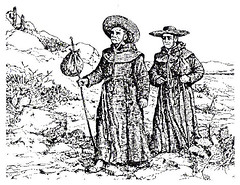
Pilgrims were a frequent sight on the roads
of medieval England, and would expect
hospitality from the religious houses they
passed by.
The nuns would have hoped and expected wealthy visitors to pay towards their keep, but they could not insist on this, and they could turn nobody away.  While many monastic communities were deliberately built in remote areas (like hermits, they would try and shut themselves away from the world), the Bedfordshire houses at Harrold, Elstow and Chicksands were all on busy medieval roads.

In the late 14th and early 15th centuries the nuns of Harrold had to plead poverty, citing their duty to "maintain great and expensive hospitality" through being close by the public road.  At this time one of the Bedford to Northampton roads passed through Pavenham and crossed the Great Ouse at Harrold bridge. According to the Viatores, at least some of this road was Roman in origin, and stretched back to Biggleswade. When it reached the Chellington and Carlton area it would have linked up with another former Roman road linking Wellingborough (a busy medieval market town), Irchester and Fenny Stratford on the old Watling Street in what is now Milton Keynes.  Apart from the wealthy, pilgrims and official travelers Harrold would have had to provide for the poor and homeless of the area for nearly four hundred years.

It is interesting to note that nearby Lavendon Abbey cited the same ruinous costs of providing hospitality to those coming along the high roads as a reason for financial hardship in the community. Although there were monastic communities at various time in Bedford, Northampton and Wellingborough, as well as in Lavendon, Harrold would have been the only provider of charity in a locality including Chellington, Carlton, Stevington, Odell and Sharnbrook.  With rich farmland and rising temperatures in the early medieval period, the population of this part of Bedfordshire boomed, with most of the local churches having to build new chapels and add aisles in the 13th and 14th centuries.  This growth stopped in about 1350 with the arrival of the Black Death.

Who was available to care for the sick at this time?  In the absence of any formal medical care it would have probably fallen to the nuns of Harrold Priory.   Chellington, just across the river from the priory, had been a busy and prosperous village up until this period, and there is speculation that the population was decimated by the Black Death or plague, with survivors moving to surrounding villages.


Sources
  • William Page (editor) (1912), A History of the County of Bedford: Volume 3, Victoria County History, pp.63-68
  • Power, Eileen (2010), Medieval English Nunneries: C1275 to 1535, Cambridge University Press
  • Viatores (1964), Roman roads in the south-east midlands, Victor Gollancz
  • 'House of Premonstratensian canons: The abbey of Lavendon', A History of the County of Buckingham: Volume 1 (1905), pp. 384-386. URL: http://www.british-history.ac.uk/report.aspx?compid=40317

Thursday, 21 August 2014

Sequere pecuniam: Follow the money


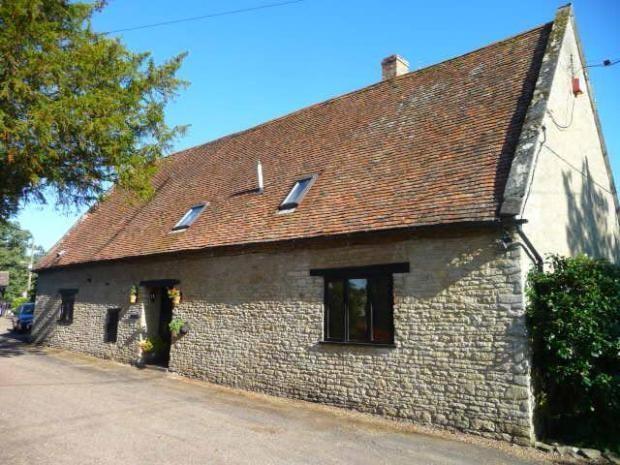
The Tythe Barn, Harrold. Close to the Priory site but
not medieval.    Source: rightmove.co.uk
The foundation of Harrold Priory was based on the grant of the churches of Harrold and Brayfield to the new community.  These had been inherited by Albreda de Blosseville from her father, who held the manor of Harrold. They were then gifted by Albreda's husband Samson le Fort to the priory.  These churches would in turn yield an income sufficient to pay for the upkeep of the churches, the costs of the cannons (priests) serving in them, and provide a surplus besides.  The revenue would mostly have come in the form of tithes (a quantity of the crops grown each year), or occasionally in services rendered or rarely in coin.  The immediate area was some of the richest agricultural land in England and so the priory should have been well provided for.  A 17th century building named 'The Tythe Barn' still stands today on Church Walk in Harrold, right on the corner of what would have been the precincts of the St Peter's church and the priory. This is unlikely to have ever served for receiving tythes as the practice had died out by this period.

This type of transaction was normal in the early medieval period, especially in England, when there was very little coin in circulation in the countryside except at harvest time, when accounts were settled and labourers were paid their wages for the year.  So it was normal practice to gift property to the monasteries and nunneries, and many of these were adept at managing these effectively to maximise their revenues. Bruce Vernarde points to the detailed accounts for Fontevraud abbey in France in the 12th century to show that almost all donations were of land, with building and revenue from customs and tolls coming a distant second and third.  It was also the case that most of Fontevraud's purchases were of land and buildings (especially mills).  It is not known if the water mill which still exists in Harrold was ever part of the priory's patrimony: a mill is listed in the 11th century Domesday book but it does not appear explicitly in Harrold Priory's cartulary.

During the four centuries following the foundation, the priory would have continued to receive grants of land and buildings, as well as occasional sums of money and annual grants of grain or other produce.  These 'gifts' would invariably accompany the entry of a new nun or novice to the community.  Religious communities were not allowed to charge new members or their families for entry - this constituted 'simony' and was frowned on by the church.  Instead they had to rely on 'donations' accompanying the 'gift' of the woman in question to the community.   In the formal documentation which accompanied a new arrival, these gifts may have been expressed in spiritual terms: but as Kathleen Cooke has observed they were understandable in terms of cost-effective solutions to long-term care for elderly widows, provision for unmarried daughters or care homes for the terminally ill. A life in a nunnery, as far as families were concerned, could be seen as a good investment.

From the Harrold cartulary we know that Baldwin des Ardres, Count of Guisnes granted the church of Stevington some time before 1153.  The church of Shakerstone in Leicestershire came to Harrold in the 15th century but the priory, historians seem agreed, was never rich. While at Fontevraud the first prioress Petronille de Chemillé proved to be an excellent steward, actively developing 'the business' through shrewd management and acquisitions, there appears to have been no equivalent prioress at Harrold, which continued to live off its modest landholdings until the end, making the occasional plea for charity.

Bedford's Community Archives describe the priory's financial position as follows:

"A partially complete account roll for 1401-1402 has survived in the ownership of the Boteler family and was transcribed by G.D.Gilmore in Volume 49 of the Bedfordshire Historical Records Society publications called Miscellanea [1970]. It shows that the priory made a small surplus but was certainly not rich.

"The house's lands were never great, in fact in 1291 Pope Nicholas did not bother to include the house in his taxation of the church. In the Hundred Rolls of 1274-1279 the priory is recorded as owning 410 acres of land. By 1340 this figure had actually fallen to about 360 acres. 

"When the foundation was dissolved it was described as having an income of £57/10/- of which £31 came from four rectories (Harrold, Cold Brayfield, Stevington and Shakerstone) £13/18/- from land in Harrold and £12/12/- from small rents in seventeen different villages."


Sources
  • Cooke, Kathleen (1990), "Donors and Daughters: Shaftesbury Abbey's benefactors, endowments and nuns, c1086-1130", Anglo Norman Studies. 12 pp. 29-45
  • Venarde, Bruce L. (1997), Women's monasticism and medieval society: nunneries in France and England, 890-1215, Ithaca: Cornell University Press
  • 'House of Austin nuns: The priory of Harrold', A History of the County of Bedford: Volume 1 (1904), pp. 387-390.  http://www.british-history.ac.uk/report.aspx?compid=40042